It was against this backdrop that García Lorca was taken on, with a play that effectively brought together the conflicts characteristic of his earliest writing: the loss of innocence; the struggle between body and soul; impossible love; and the tensions between the poetic vocation and a hostile society branded by utilitarianism. The Estrella del Prado device had already made an appearance in Impresiones y Paisajes, in a chapter devoted to Baeza, featuring a girls’ choir singing (IV, 114). As Tadea Fuentes (1990) noted, this was simply a switch Lorca had made in the lyrics, swapping the line “El treinta de mayo” for “Estrella del Prado” in a traditional folk song: “El treinta de mayo / al campo salí / a coger las flores / de Mayo y Abril” (page 39).
Of particular interest to us is the fact that Estrella del Prado also appears in Balada Triste (Sad Ballad), from his Libro de Poemas. The composition begins thus:
My heart is a butterfly,
Good children of the meadow!
Trapped by time’s grey spider,
Bearing the deadly pollen of disillusionment!
(García Lorca, 1996, I: 77)
We are not attempting here to identify Lorca with the character of the Butterfly in his first work for theatre. Rather, we can place the text within the context of destiny and the disillusionment that all those touched by poetry or frustrated love must suffer. The appearance of a book of verse in a tranquil meadow may signify a disruption not unlike that of the butterfly that falls into a nest of cockroaches. Imagination and desire are associated with the loss of innocence because they upset the routine and move us to pursue—as Curianito well knows—“something [one] can never have!” (IV, 172).
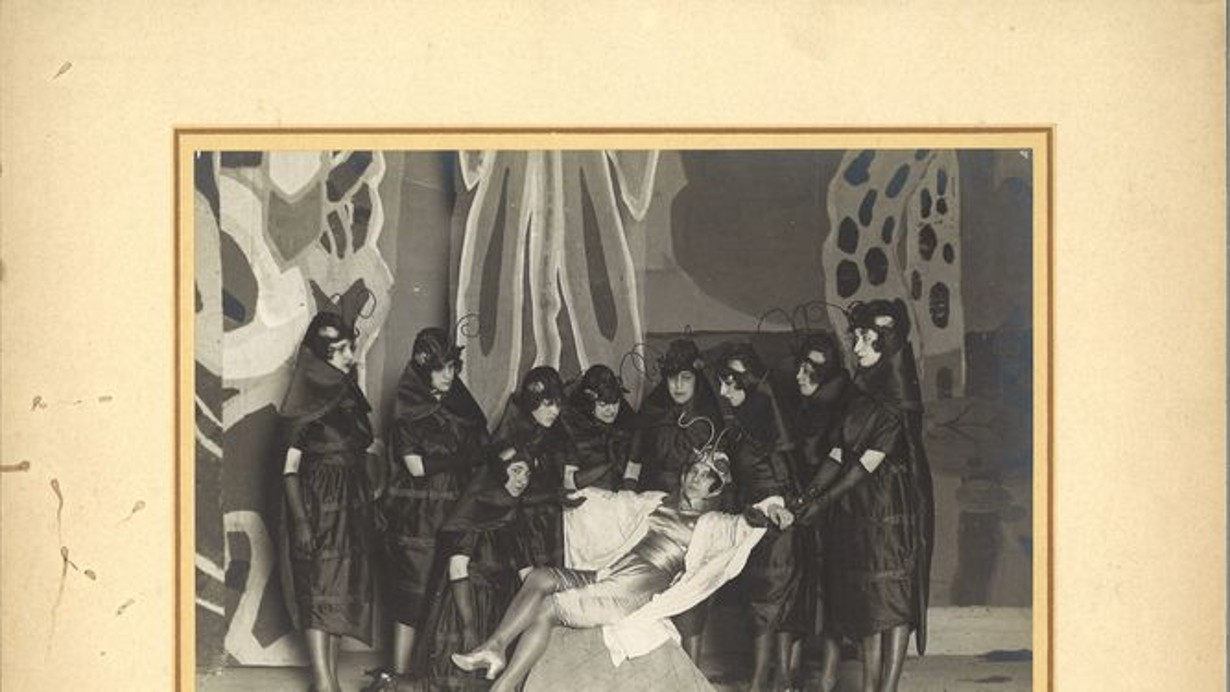
Curiana the Necromancer expresses a wish for reconciliation: “Cooking and poetry can be combined” (IV, 173). But, as the play unfolds, we see this reconciliation is impossible, for various reasons. Doña Curiana is an enemy of poets, because of their baneful uselessness:
“There is no misfortune so great as to be a poet” (IV, 200).
The Scorpion contemptuously associates poetry with compassion and sentiment, and Curianito, who lives inside the wound, understands the Butterfly better than anybody when she declares: “For I am death / And beauty” (IV, 201). As Luis Fernández Cifuentes (1986) observes, Curianito embodies the tragic aspect of the play, falling in love with someone whose very condition renders happiness impossible in the tug-of-war between desire and reality—or, as we might say—between the public and the private (page 39). This is made clear by Curianita I, who says:
This is no chimera. This is evidence of a problematic reality.
Once again, Lorca extends the personal (his inquiry into his own identity) outward, into the heterodoxical. As Soria Olmedo (1994) noted, “for this concept of heterodoxy not to be meaningless, we must remember that it was along similar lines to the heterodoxy spread by fin-de-siècle modernism and its romantic tradition” (page 19).
In the months during which he was writing El Maleficio, from June 1919 to March 1920, Lorca wrote other texts for the theatre, some of which also feature animals as protagonists. Pantheism, and a consciousness in which all of nature is one, is fertile ground for a belief in the complicity between the great and the small, and for making meaning of an energy that moves toward metamorphosis. Sombras (Shadows), dated 9 February 1920, is a dialogue between spirits awaiting reincarnation. In La Sombra de Sócrates we hear that:
What was it that failed to fulfil the audience’s expectations in El Maleficio? For those who saw the performance at the Eslava theatre, the symbolic use of animals was enshrined in symbolism. But the cockroach, according to most of the play’s critics, came across as a repugnant being, better-suited to comedy than to the creation of poetic effect. In fact, the performance completely upturned what was originally planned. If puppets have the effect of diminishing the human being by reducing it down to the place of the marionettes so as to set a certain perspective and tone, then actors in cockroach costumes only succeeded in taking this sense of disproportion to its opposite extreme. As Álvarez Cifuentes observed:
Problems relating to social mores or the passage of time and its elasticity—themes that would subsequently provide rich material for Lorca’s avant-garde theatre and his explorations of identity—somehow acquire a certain fragility when expressed by Doña Curiana. They become unconvincing, even amusing, when heard from the actress Rafaela Satorres, dressed as a cockroach. She addresses a young Curianita Silvia:
You are very much in love,
I know. But in my day
Young women did not look
For sweethearts so flagrantly,
Nor did we speak in fables
Like you do. Modesty
Was more the way
Than today. There’s a tale
Of a cockroach so pure
She remained a spinster
And lived to the age of six. I
Am two months old and decrepit.
And all because I married! Oh!
 (García Lorca, 1996, IV: 177)
Melchor Fernández Almagro (1976), referring to the premiere, recalled Lorca’s friends applauding, in an attempt to compensate for the poor opinion of the audience, and then reflected:
Along similar lines, some modern critics have also attempted to defend the value of El Maleficio de la Mariposa as a major work. But more objective, perhaps, is the sense evoked by Mora Guarnido, who acknowledges the mistakes committed in the performance but then puts forward the view that the main weight of responsibility should not lie with the young author. In around 1920, by the time modernism was firmly entrenched (and in many ways weighed down with conventions), and the avant-garde was yet to make its presence felt, the concept of teatro de ensueño (theatre of dream-like fantasy) that Martínez Sierra wanted to revive with El Maleficio found itself in no-man’s-land. The contradiction between solemn poetry and inconsequential elements was not about to be convincingly resolved.
Once again, Francisco García Lorca (1980) puts the record straight when he writes: “It is impossible to think back on those times without melancholy, when a thirst for renewal met inexperience, ambition and adolescence in a little drama not without its hint of dark comicality” (page 263). The poet’s brother recognizes that this dramatic piece was simply not viable “despite striking some of the right expressive chords, and the tender, guileless poetry of certain elements” (page 265).
¡Mi corazón es una mariposa, Niños buenos del prado! Que presa por la araña gris del tiempo Tiene el polen fatal del desengaño! (García Lorca, 1996, I: 77)
No hay desgracia mayor que la de ser poeta (IV: 200).
Y de una mariposa, ¿por qué se ha enamorado? / ¿No sabe que con ella no podrá desposarse? (García Lorca, 1996, IV: 197).
El mundo es un juguete sin dueño… Yo me he transformado sucesivamente en gato, en rana, en flor, en sombra y volveré otra vez a ser hombre, y así sucesivamente… (García Lorca, 1996, IV: 1002).
Lo que propone El maleficio es el agigantamiento de lo ínfimo, pero con una dificultad especial: la imagen de la cucaracha, a diferencia de la de tantos otros animales, no había adquirido un status artístico que permitiera resumirla en determinados rasgos convencionales (1986: 32-33).
Estás muy enamorada, Ya lo sé. Mas en mi época Las jóvenes no pedíamos Los novios a boca llena, Ni hablábamos en parábolas Como hablas tú. La vergüenza Estaba más extendida Que en estos tiempos. Se cuenta De una curiana muy santa Que permaneció soltera Y vivió seis años. Yo Dos meses tengo y soy vieja. ¡Todo por casarme! ¡Ay! (García Lorca, 1996, IV: 177)
La verdad es que El maleficio de la mariposa fracasó escandalosamente. Aunque hubiese alcanzado una interpretación felicísima, habría sido hostilizada por la mayoría de los espectadores. Estas primeras batallas contra un gusto o un estilo imperante se pierden siempre, y más cuando se trate de renovar, innovar, crear, peor para el que acometa empresa semejante (58).