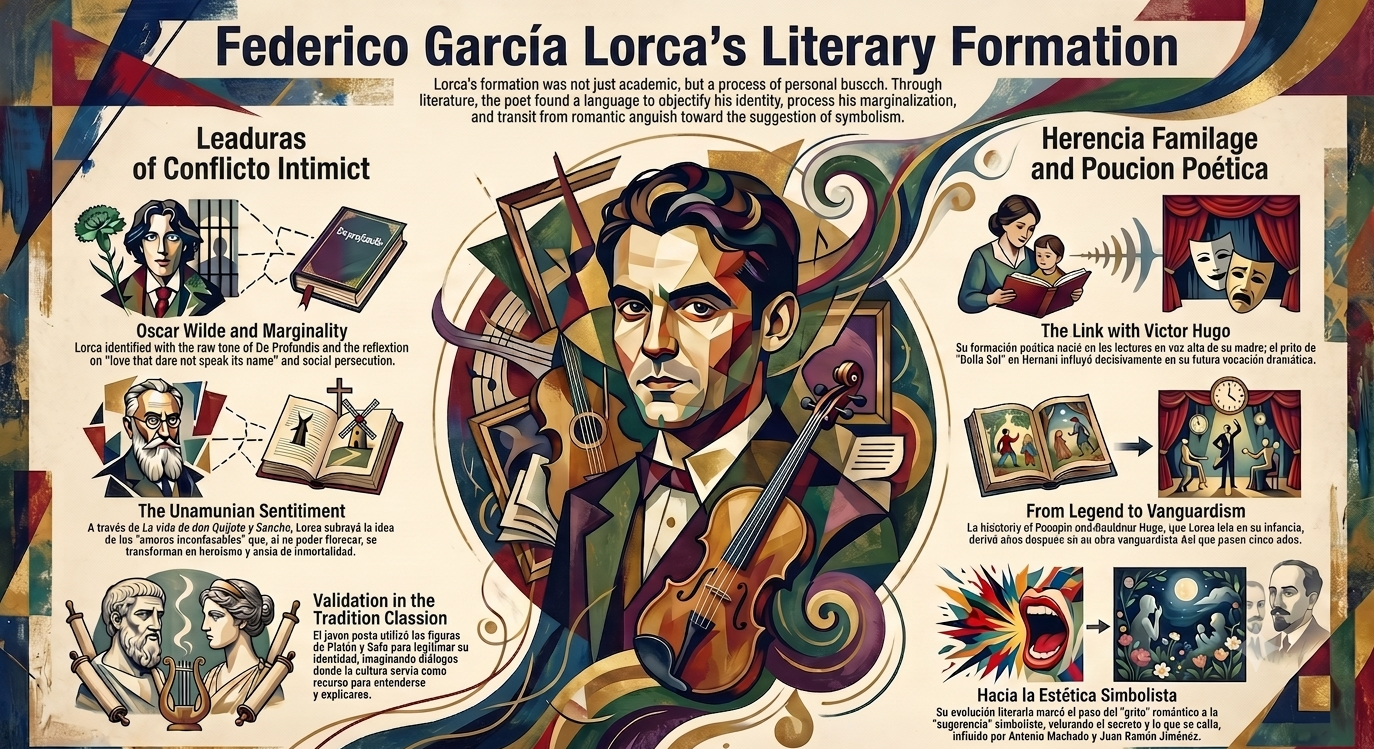
Manuel Fernández-Montesinos, nephew of the poet, published Datos sobre la Biblioteca de Federico García Lorca (On the Library of Federico García Lorca) in 1988. Here we see that, among the items conserved by his family, there are certain passages from books that Federico himself had underlined. In Miguel de Unamuno’s Vida de Don Quijote y Sancho (Life of Don Quijote and Sancho), the young García Lorca had highlighted the following reflections on the story of Marcela the shepherdess:
(1988: 18).
The personal lens through which Lorca reads Unamuno can readily be linked to his innermost concerns—as someone whose very desires force him to accept his homosexuality, condemned by convention to live in conflict with society and with himself. As Christopher Maurer observed in 1994, the struggle between flesh and spirit is a recurring theme throughout the prose Lorca produced as a young man, obsessively filling entire notebooks between 1917 and 1918.
Lorca’s library also contains an edition of Oscar Wilde’s De Profundis (with a prologue by André Gide), in which, once again, the poet has underlined significant passages. De Profundis was the letter Wilde wrote during his imprisonment in Reading Gaol to his young, unscrupulous lover, Lord Alfred Douglas. Wilde spent two years in prison, between 1895 and 1897, having unsuccessfully attempted to sue Douglas’s father, the Marquis of Queensberry, for criminal libel (with Douglas’s full support). Wilde’s efforts to defend himself from the Marquis’s incessant insults were in vain, as he not only lost the case but was immediately arrested and sentenced to imprisonment on the grounds of gross indecency.
.jpg)
The brutal tone of the book and the associated persecution of “the love that cannot speak its name” must have made quite an impression on García Lorca. But there are many aspects of Wilde’s reflections that were not out of place in the young literary world Lorca had unleashed some two years before he read these writings of Wilde’s. Examples of such reflections include references to the figure of Christ presented as a romantic hero, his admiration for Shakespeare and Francis of Assisi, his attraction to the mystical experience that endeavours to resolve the tensions between flesh and spirit, and the configuration of an unbreakable bond between love and pain, out of which the most worthy motives of the human condition emerge. Lorca underlines the following words:
“Now it seems to me that love of some kind is the only possible explanation of the extraordinary amount of suffering that there is in the world” (page 68).
He is also drawn to those parts of the text that speak to marginalization:
“It [society] is really ashamed of its own actions, and shuns those whom it has punished, as people shun a creditor whose debt they cannot pay, or one on whom they have inflicted an irreparable, an irremediable, wrong” (page 57).
The romantic world of Lorca would surely have felt fascinated by some of Wilde’s maxims:
“Every effect that one produces gives one an enemy. To be popular one must be a mediocrity or “All charming people, I fancy, are spoiled. It is the secret of their attraction”.
Hay amores que no pueden romper el vaso que los contiene y se derraman hacia adentro, y los hay inconfesables, a los que el destino formidable oprime y constriñe en el nido en que brotaron; el exceso mismo de aquellos los cuaja y los encierra, la tremenda fatalidad de estos los sublima y engrandece. Y presos allí, avergonzándose y ocultándose de sí mismos, empeñándose por anonadarse, bregando por morir, pues no pueden florecer a la luz del día y a la vista de todos, y menos fructificar, se hacen pasión de gloria y de inmortalidad y de heroísmo... Solo los amores desgraciados son fecundos en frutos del espíritu; solo cuando se cierra al amor su curso natural y corriente es cuando salta en surtidor al cielo; solo la esterilidad temporal da fecundidad eterna.